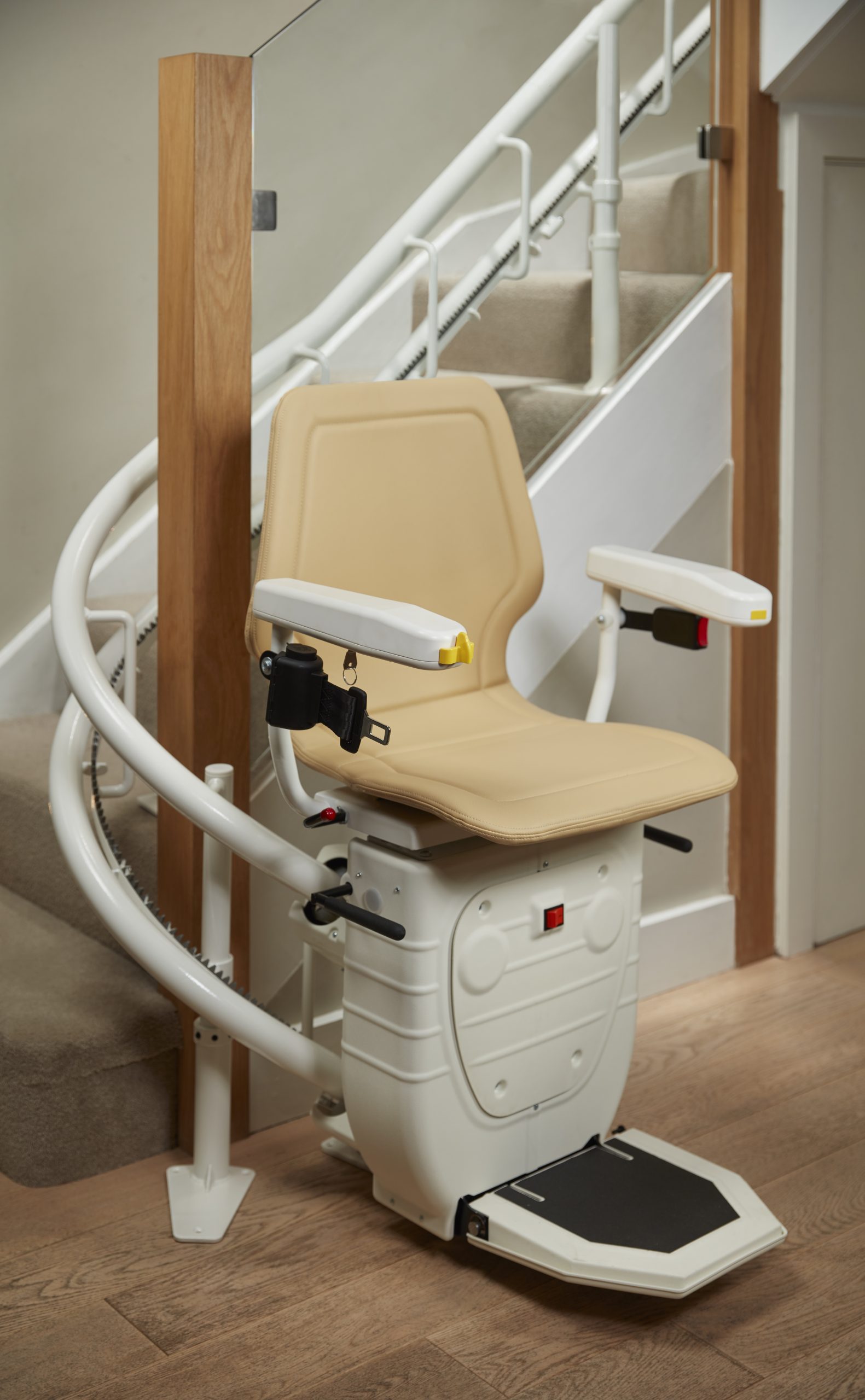
If you live in a classic Victorian terrace, a quaint cottage, or a modern townhouse with a particularly tight hallway, you might have looked at your stairs and thought that there is no way a chair is fitting there. It is a common concern across the UK, where historical architecture often prioritises character over wide, sweeping stairwells. However, the good news is that home mobility technology has advanced significantly by 2026.
At Lifestyle Stairlifts, we specialise in finding solutions for even the most difficult homes. Having a narrow staircase should not mean you have to sacrifice your independence or consider moving house. This guide explores the best slimline options available and the clever design features that make safe travel possible in tight spaces.
The Challenge of Narrow Stairs in British Homes
The average staircase in a modern UK home is roughly 80cm to 90cm wide. However, in many older properties, especially the steep, winding stairs found in Yorkshire’s industrial-era terraces, widths can drop significantly. The primary challenge is not just fitting the chair itself: it is ensuring there is enough room for the user to travel comfortably without hitting the opposite wall or the banister.
Furthermore, a staircase is often a shared space. If you live with family or frequently have visitors, you need a solution that does not turn the stairs into a permanent obstacle for those who are walking up and down. This is where slimline and compact designs become essential for the modern home.
Key Features to Look For in a Narrow-Access Stairlift
When we assess a home with limited space, we look for several specific engineering features that can reclaim precious centimetres of walkway. If you are researching options, keep these three features in mind:
Ultra-Slim Rail Designs
The rail is what the chair glides along. In the past, these were bulky and sat quite far out from the wall. Modern rails are far more discreet. Some of the latest models feature rails that sit very close to the wall. For straight stairlifts, a single-rail system is often the least intrusive, while for curved stairlifts, we look for modular or twin-rail systems that can hug the tightest corners of a banister.
Powered Folding Components
When the stairlift is not in use, it should be able to tuck itself away. Look for chairs where the seat, armrests, and footplate all fold up flat against the wall. Some premium models feature a powered footrest, which allows you to fold the footplate at the touch of a button on the armrest. This saves you from having to bend down in a cramped hallway, which is a major safety benefit.
The Perch Seat Solution
For exceptionally narrow staircases, a traditional seated lift might not be viable because the user’s knees would protrude too far forward. In these cases, a perch or standing stairlift is a brilliant alternative. These lifts allow you to travel in a semi-standing position with a small, secure seat for support. Because you are not sitting fully back, your profile is much slimmer, allowing the lift to pass through narrower gaps safely.
Leading Stairlift Models for Tight Spaces in 2026
Based on our experience with local installations in West Yorkshire and beyond, several models stand out as the best for narrow-access mobility:
Access BDD Flow X
The Flow X is widely regarded as one of the most versatile curved stairlifts on the market. It is specifically designed for narrow stairs, featuring unique Advanced Swivel and Levelling technology. This allows the chair to rotate while it is moving, effectively turning the user away from the narrowest parts of the staircase as it glides past. It can fit on staircases that were previously thought to be impossible to adapt.
Handicare 2000
For a straight flight of stairs, the Handicare 1100 is often our first recommendation. It uses a grease-free rail system that is incredibly slim and easy to keep clean. Because there is no oily rack and pinion, the rail can be positioned very close to the wall, leaving more room for other people to walk past. It is a quiet, reliable, and very discreet option for a narrow hallway.
Clever Ways to Reclaim Space on Your Stairway
One of the most important aspects of a narrow stair installation is safety for the rest of the household. If a rail protrudes too far at the bottom, it becomes a tripping hazard. To solve this, we often recommend a powered hinge. This allows the bottom section of the rail to fold up automatically when the lift is at the top of the stairs, keeping the floor clear of any metal track.
We also pay close attention to the parking position. By using a curved rail that wraps around the banister at the top or bottom landing, we can ensure the chair is parked completely out of the way of the main walkway. This is especially useful in homes where the stairs open directly into a living room or a narrow entrance hall.
Why a Professional Home Survey is Essential
Choosing a stairlift for a narrow staircase is not something that can be done from a brochure alone. Every millimetre counts, and a professional survey is the only way to ensure the lift will actually fit and that it will be comfortable for you to use. An engineer will measure not just the stairs, but your seated knee to back length to ensure you have enough clearance from the opposite wall.
At Lifestyle Stairlifts, we understand the specific architectural quirks of UK homes. Whether you are in a steep cottage or a property with a winding stone staircase, we have likely seen a similar layout before. We also offer reconditioned stairlifts, which can be a great way to access premium slimline technology from top manufacturers.
The era of bulky, intrusive stairlifts is over. With modern tilt and swivel technology, ultra-slim rails, and clever folding designs, almost any staircase can be made accessible. If you have been told before that your stairs are too narrow, it might be time for a second opinion with the latest 2026 models.
Is your staircase on the narrow side? We can help you find a solution that fits your home and your lifestyle perfectly. Contact our friendly team today for a free, no-obligation home survey.